Selected publications

Research

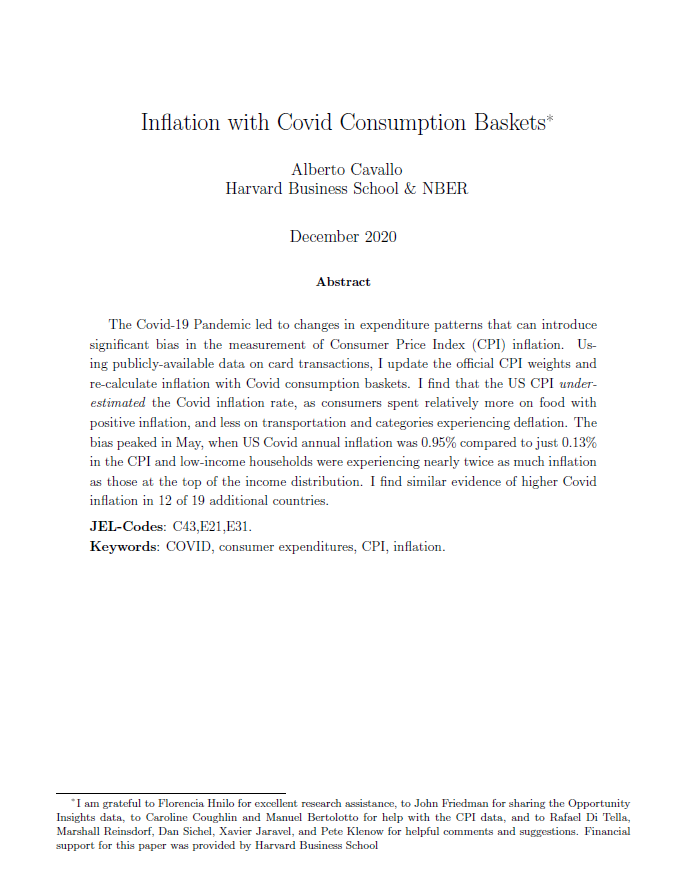
Chart from Inflation with Covid Consumption Baskets

Inflation with Covid Consumption Baskets

Alberto Cavallo

NBER Working Paper Series, No. 27352

The Covid-19 Pandemic led to changes in expenditure patterns that can introduce significant bias in CPI inflation. Using publicly available card-transaction data, this paper updates official CPI weights and recalculates inflation with Covid consumption baskets. It finds that the US CPI underestimated Covid inflation, with similar evidence in 12 of 19 additional countries.
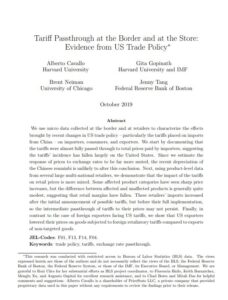
Tariff passthrough paper cover

Tariff Passthrough at the Border and at the Store: Evidence from U.S. Trade Policy

Alberto Cavallo, Gita Gopinath, Brent Neiman, and Jenny Tang

American Economic Review: Insights, Vol. 3, Issue 1, March 2021

Using data collected at the border and at retailers, this research studies the effects of recent US tariffs on importers, consumers, and exporters. Tariffs were almost fully passed through to prices paid by importers, while effects on retail prices were more mixed and retaliatory tariffs led US exporters to lower prices.

Targeted price controls research

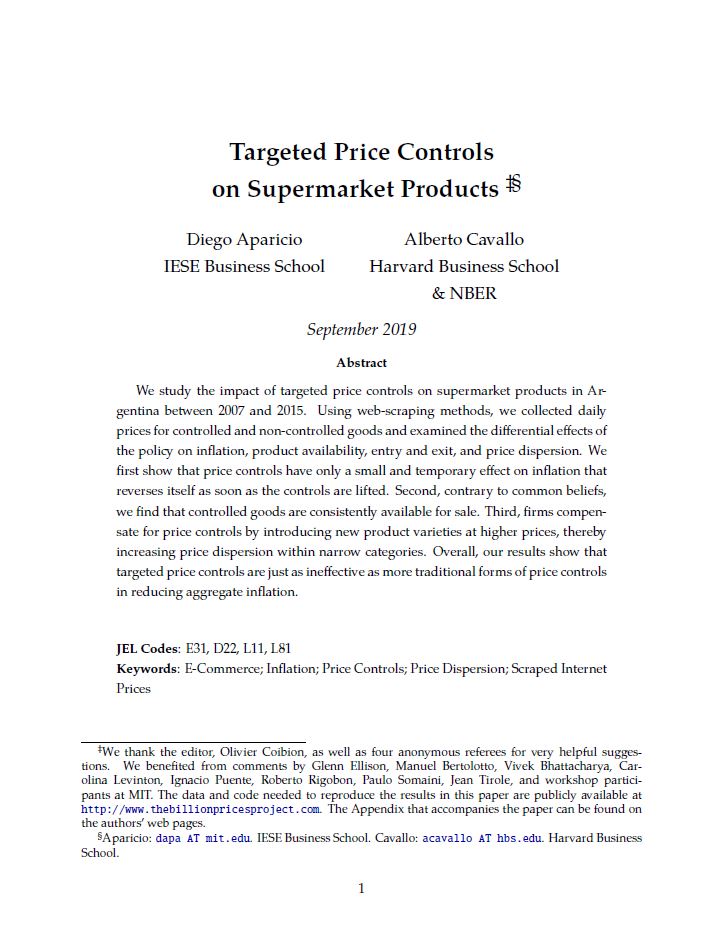
Targeted Price Controls on Supermarket Products

Diego Aparicio and Alberto Cavallo

Review of Economics and Statistics, Vol. 103, No. 1, March 2021

Daily supermarket prices from Argentina are used to examine targeted price controls. The controls had a small, temporary effect on inflation; controlled goods remained available; and firms introduced new product varieties at higher prices, increasing price dispersion.

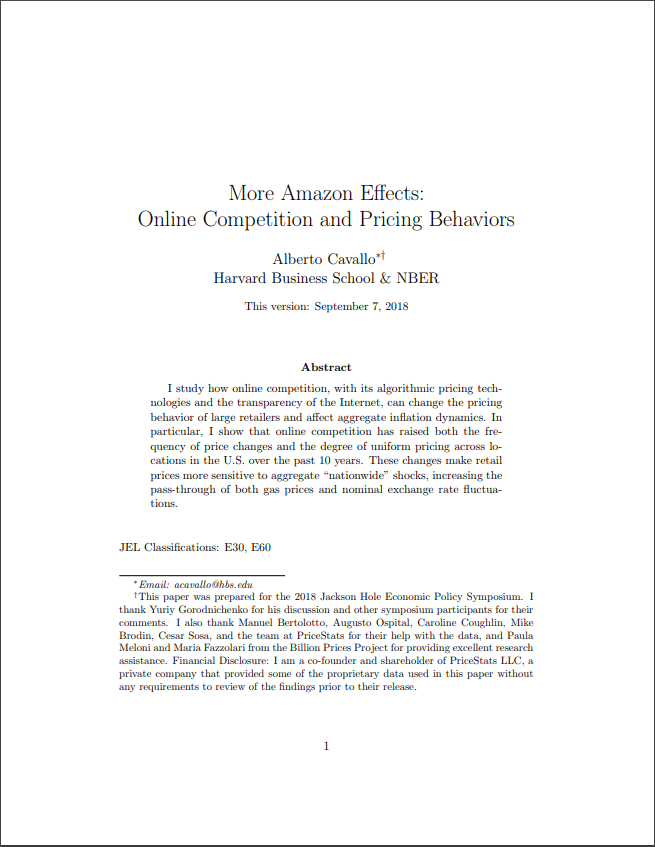
More Amazon Effects paper

More Amazon Effects: Online Competition and Pricing Behaviors

Alberto Cavallo

Jackson Hole Economic Symposium — Federal Reserve Bank of Kansas City, 2018

Online competition, algorithmic pricing, and price transparency have raised the frequency of price changes and increased uniform pricing across US locations. These changes make retail prices more sensitive to nationwide shocks, including gas prices and exchange-rate fluctuations.

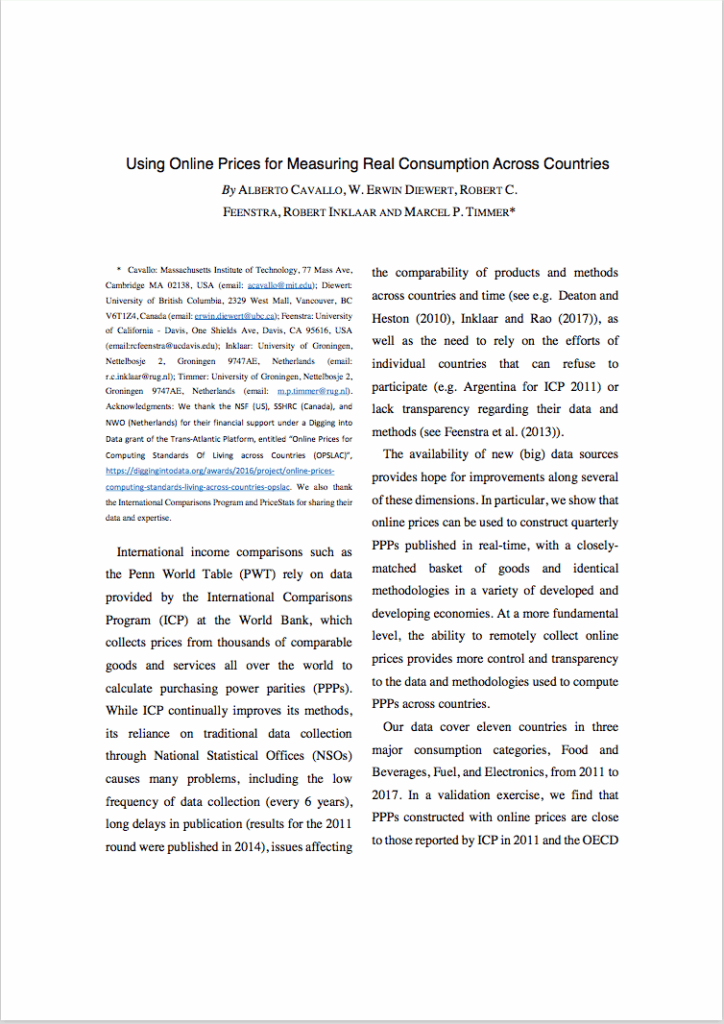
Real consumption paper cover

Using Online Prices for Measuring Real Consumption Across Countries

Alberto Cavallo, W. Erwin Diewert, Robert C. Feenstra, Robert Inklaar, and Marcel P. Timmer

American Economic Association — Papers and Proceedings, Vol. 108: 483–487

Online prices can be used to construct quarterly purchasing power parities with closely matched goods and identical methods across countries, producing more current estimates of real consumption without relying on consumer-price-index extrapolations.

Online and offline prices research

Are Online and Offline Prices Similar? Evidence from Large Multi-Channel Retailers

Alberto Cavallo

American Economic Review, Vol. 107, No. 1, January 2017

A large-scale comparison of prices collected simultaneously from websites and physical stores at 56 retailers in 10 countries finds identical price levels about 72 percent of the time. Price changes are not synchronized, but have similar frequencies and average sizes.

The Billion Prices Project paper cover

The Billion Prices Project: Using Online Prices for Measurement and Research

Alberto Cavallo and Roberto Rigobon

Journal of Economic Perspectives, Spring 2016, Vol. 30(2): 151–178

This overview describes how online prices can improve economic measurement and research, construct daily price indexes across countries, and reduce measurement biases that distort evidence on price stickiness and international relative prices.

Inflation expectations study

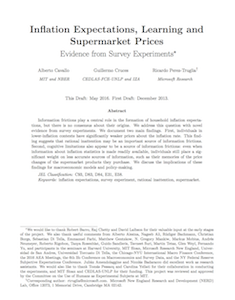
Inflation Expectations, Learning and Supermarket Prices — Evidence from Survey Experiments

Alberto Cavallo, Guillermo Cruces, and Ricardo Perez-Truglia

American Economic Journal: Macroeconomics, Vol. 9, No. 3, July 2017

Survey experiments show that people in lower-inflation contexts have weaker priors about inflation, consistent with rational inattention. Cognitive limits also matter: even when official information is readily available, households continue to rely on memories of supermarket price changes.

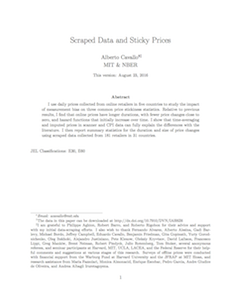
Scraped Data and Sticky Prices

Scraped Data and Sticky Prices

Alberto Cavallo

Review of Economics and Statistics, Vol. 100, No. 1, March 2018

Daily online prices from five countries show longer durations, fewer near-zero price changes, and initially increasing hazard functions. Time averaging and price imputation can explain key differences from earlier results based on scanner and CPI data.

Currency unions research

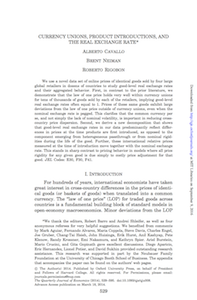
Currency Unions, Product Introductions, and the Real Exchange Rate

Alberto Cavallo, Brent Neiman, and Roberto Rigobon

Quarterly Journal of Economics, Vol. 129, No. 2, May 2014

Prices of identical goods sold by four global retailers show that the law of one price holds remarkably well within currency unions. Outside them, substantial differences persist, and most reflect prices set when goods are first introduced.

Argentina inflation index research

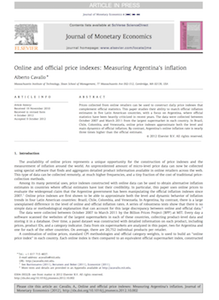
Online and Official Price Indexes: Measuring Argentina’s Inflation

Alberto Cavallo

Journal of Monetary Economics, Vol. 60, No. 2, May 2013

Online supermarket prices reproduce the level and main dynamics of official inflation in Brazil, Chile, Colombia, and Venezuela. In Argentina, however, online inflation was nearly three times higher than the official estimate.

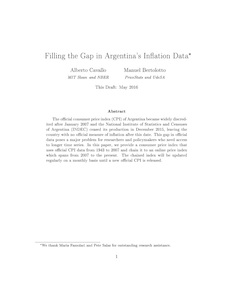
Filling the Gap in Argentina’s Inflation Data

Filling the Gap in Argentina’s Inflation Data

Alberto Cavallo and Manuel Bertolotto

May 2016

This paper provides a consumer price index that links official CPI data from 1943–2007 to an online price index beginning in 2007, filling the gap created when Argentina’s official CPI became discredited and was later discontinued.

Household inflation perceptions research

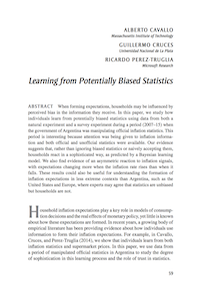
Learning from Potentially Biased Statistics: Household Inflation Perceptions and Expectations in Argentina

Alberto Cavallo, Guillermo Cruces, and Ricardo Perez-Truglia

Brookings Papers on Economic Activity, Spring 2016

Households exposed to potentially biased official inflation statistics do not simply ignore or accept them. Evidence from natural and survey experiments points to sophisticated Bayesian learning and an asymmetric response when inflation signals rise rather than fall.

Latvia currency union research

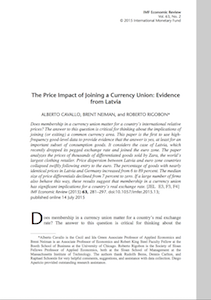
The Price Impact of Joining a Currency Union: Evidence from Latvia

Alberto Cavallo, Brent Neiman, and Roberto Rigobon

IMF Economic Review, Vol. 63, No. 2, September 2015

After Latvia joined the euro, price dispersion with euro-area countries collapsed rapidly for thousands of Zara products. The share of nearly identical Latvia–Germany prices rose from 6 to 89 percent and the median price difference fell to zero.

Border effects research

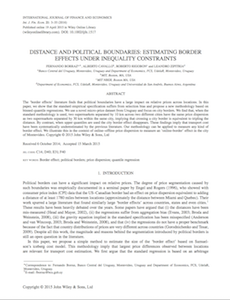
Distance and Political Boundaries: Estimating Border Effects under Inequality Constraints

Alberto Cavallo, Fernando Borraz, Roberto Rigobon, and Leandro Zipitria

International Journal of Finance & Economics, Vol. 21, No. 1, April 2015

A new methodology based on binned-quantile regressions shows that common estimates of city-border effects are affected by selection bias. Applied to supermarket prices in Uruguay, the estimated city-border effect disappears in upper quantiles.

Natural disasters and prices research

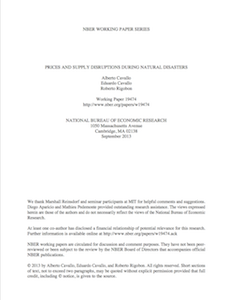
Prices and Supply Disruptions during Natural Disasters

Alberto Cavallo, Eduardo Cavallo, and Roberto Rigobon

Review of Income and Wealth, Vol. 60, 2014

Following the 2010 Chile earthquake and 2011 Japan earthquake, product availability fell sharply and recovered slowly while prices remained stable for months—even for goods experiencing severe shortages.

Distribution of price changes research

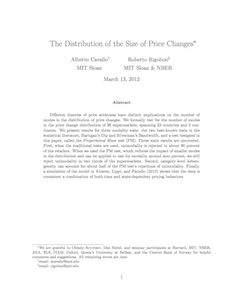
The Distribution of the Size of Price Changes

Alberto Cavallo and Roberto Rigobon

NBER Working Paper 16760, March 2012

Price-change distributions from 36 supermarkets in 22 countries reject unimodality in most retailers. Category-level heterogeneity explains about half of the rejections, and simulations support a combination of time- and state-dependent pricing behavior.